
chiropractor downers grove

Dr. Andy Boyce – Your Downers Grove Chiropractor

Strength is often a misinterpreted quality when considering its relation to different sports. 

When people hear strength, they think of big and strong power lifters, strongmen, linebackers, or the jacked Crossfitters who seem to be good at everything that involves picking up a barbell. 

While it’s true that ALL of these sports do require significant amounts of strength, the function of strength is often overlooked when looking at endurance sports such as running and cycling. 

This to the detriment of many runners and cyclists performance. 

Let’s take a deeper look.

Definition of Strength

First, we need to look at what the actual definition of strength is before we go any further. 

Strength can be defined as the ability to apply force against an external load.  Going a little deeper, we can define force by Newton’s 2nd law, Force= Mass x Acceleration. 

Simple algebra tells us that in order to increase the amount of force generated, we need to do one of two things, increase the mass we are moving (adding more weight on the bar), or increase the rate of speed of the object we are moving, this can be a barbell or our bodies against gravity.

Utilizing Newtons 2nd law throughout training programs is a way to consistently generate high amounts of force without constantly being under a high load.

This can help moderate the amount of stress that is placed on the body, ensuring it is a beneficial type of stress (eustress) to stimulate an adaptation, and not a distress, which can lead to overtraining and injury. 

This is one of the basic principles of the conjugate style of training, something that will be covered in a different post. 

Physics aside, we need to go into further depth at the application of strength in the context of endurance events.  

Downers Grove Runners Pay Attention

Lets look at runners as our example. 

We can define endurance events as repeated submaximal contractions of a muscle over an extended period of time. 

In the case of running, this means all the muscles involved in the stride are generating submaximal amounts of force every single stride. 

So, over the course of a marathon the muscles responsible for moving the legs might be contracting at 20% of their maximal force output. 

The muscles will contract submaximally over the course of the race, increasing the force of contraction during surges or during the final kick of the race.

Improvements in strength don’t change the fact that endurance challenges are repeated submaximal contractions over an extended period of time, but it does make that 20% of maximal contraction more forceful each and every stride. 

This improvement in strength leads to improved speed, conservation of much needed energy, and an increase in mechanical efficiency. 

Improvements in strength also play a role in decreasing injury risk on two different levels. 

Firstly, stronger people are more hardy and resilient, it takes more for them to get hurt. 

Two important things to consider while programming strength training for runners is that it improves tendon strength and bone density, two things that are often hurt during the course of a running program in the case of runners knee and stress fractures. 

Adding strength training to a running program also helps decrease injury risk by decreasing the amount of total mileage runners have in their program, which is quite often the reason for pain, injuries, and stagnation.

Contemporary training plans tend to overemphasize specificity part of the the SAID principle, or the specific adaptation to imposed demands. 

This means the body will adapt in a way to best handle the stress that was imposed on it in the future. 

For example, if someone practices benching heavy weight, odds are they will improve in their ability to bench heavy weight. 

Likewise, if we practice piano, we would like see an increase in our ability to play the piano. 

Running programs tend to overemphasize the specificity part in that they have their athletes run far too much during programs, leaving no time for alternative training to improve other areas of weakness. 

Not only does the excessive miles commonly lead to overtraining, injury, and eventual stagnation, but it completely ignores the fact that getting stronger (to a point) is bound to help performance.  

Replacing the junk miles, or the days when runners just go for a run to meet their quota for the week, is a great place to substitute days where we lift weights.   

Downers Grove Runners – Let’s Talk About Junk Miles

Anyone who has trained for a race knows what the junk miles are. 

They are the miles that we plod through just because they were written into our plan we “need to get a run in”. 

These are some of the silliest miles people run, they don’t provide any real benefit and all they really do is add to the accumulated fatigue, increasing the risk for injury. 

A better idea would be to replace those days with strength training, providing a novel stimulus to the body, improving strength, reducing injury risk, and improving overall performance. 

Downers Grove 

Excellent exercises to add into programs would be those that do the best job at improving overall strength. 

Downers Grove Chiropractor Uses Strength Training for Runners

These would be the squat, and the deadlift. 

Proper application of these exercises into running programs do an excellent job of increasing strength in the muscles that are utilized during running, such as the glutes and hamstrings. 

Not forgetting the SAID principle, adding single leg work is also important to improve the bodies ability to perform on one leg. 

Running is a coordinated bound from single leg to single leg with a period of floating inbetween. 

If two feet are on the ground at one time, by definition it is not a run. 

This definition highlights the importance of single leg work, such as the lunging motion, box-step ups, single leg RDLs, etc. 

My personal favorite single leg exercise is Russian step-ups. 

The extra hip flexion at the top of the lift adds an extra challenge that makes the exercise that much more fun.  
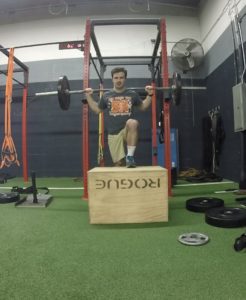
downers grove chiropractor russian step up

Starting position for the Russian step-up
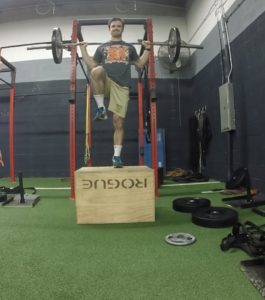
downers grove chiropractor finishing russian step up

Ending position of the Russian Step-up

Downers Grove Chiropractor Says “It’s all about Programing.”

Lastly, one common error coaches who do program lifting for their runners make is the amount of load they prescribe. 

Often, runners will perform these exercises in an unloaded fashion, or just against the force of gravity on their body. 

This can help athletes who have never performed these motions before, but the body will quickly adapt to this stimulus and its utility will eventually expire. 

Progressive increases in load, whether by weight or volume, is a tried and true way to improve upon strength, much more effectively than doing incredibly high reps of body weight squats and lunges. 

The gains in strength can be achieved in a quicker and much more efficient manner under a heavier load compared to body weight exercises until failure.

If you are a runner or an athlete who is looking to improve your performance in any race distance your Downers Grove Chiropractor is here to help. 

Click on the link above to schedule a free consultation. 

Core1 offers chiropractic care, physical therapy, and sports performance training.  


Pain is most frequently the reason people visit their chiropractor.  

“Doc my back hurts.” 

“Doc when my shoulder moves like this it hurts.”

“I woke up and my neck was killing me!”

These are some of the complaints I have heard from my patients when they present to the clinic.  I have yet to have a patient walk in telling me they have strained their quadratus lumborum or transversospinalis which is the source of their low back pain.  I tend to see a lot of athletes, Crossfitters in particular, and the more common verbiage is “the morning after my WOD my back started speaking to me.” Or something along those lines.

If you’ve talked to me before you probably have heard the phrase “pain science” thrown around along with “pain is pretty dang tricky.”  That’s because pain is rarely as straightforward as the biomechanical model would have you think.  Let’s take the low back as an example.  There are literally dozens of structures located in and around the lumbar spine that are innervated by nociceptive, or pain sensing, fibers.  This means that they can all contribute to the experience we call pain.  Many clinicians will do a physical exam, testing this and that structure, and maybe even take some imaging then come back with the conclusion that one structure is the source of their back pain and if we fix that structure you will be pain-free.  According to the evidence, this is becoming harder and harder to say with absolute certainty.  

If only it were that straightforward.   Blaming pain on one single structure is like blaming the course of world history on one single event.  It MAY have played a part in the genesis of pain, but there is always a context and other confounding factors that contribute to the current state of.  If you follow the biopsychosocial approach to healthcare, this probably makes sense to you, but if not I wrote about it HERE.  In short, pain is something that is highly nebulous in nature and can be affected by biological (physiologic processes going on inside the body), psychological (how the person interprets and feels about their pain), and social factors (factors such as work and family stress).  These factors all play a role in the pain milieu and taking a microscopic view on one single factor could potentially be more harmful than helpful.  

These different factors can all be looked at as “stressors” to the body, which are very important when considering someone in pain.  Stress can be psychological, for example, when someone is waiting for the results of a blood test.  It can be social, like trying to meet a deadline at work.  This post will focus on the physical effects of stress, such as the stress of exercise and the benefits and potential risks it brings.  

First, we need to agree that exercise in and of itself is a stress, and that is not necessarily a bad thing.  Stress can divided into two different categories.  The good stress, eustress, is a stress that you can adapt to and you are better off for it.  Think of the stress a final exam brings.  If we are adequately prepared for the test we are equipped with the knowledge required to pass the test.  We have newfound knowledge to apply and are able to continue on in our education.  This is generally a good thing.  On the other hand, distress, or bad stress, is something we are not able to adapt to and can leave us worse off.  Think about a final that you are not prepared for, you didn’t go to class and you end up failing.  This means you have to pay for the class again and you aren’t able to continue on to the next class.  This is obviously not a good thing. 

Exercise can be viewed similarly.  In the right dose, exercise provides eustress that allows the body to adapt and become more robust and resilient.  For example, when someone who is trying to get stronger utilizes the principles of progressive overload the body is able to adapt to each successive increase in weight, becoming stronger after each stimulus.  If the increase in weight is too much, or excessive volume is performed, the body cannot complete the task and will not make the necessary adaptation to become stronger and more resilient, also running the risk of overtraining and injury.  

This concept is important for athletes to understand, and I look at runners and Crossfitters in particular, due to the vast amount of volume stress they put their bodies through any given day.  For those who have adapted to the high volume snatches or the 20 mile runs on the weekend it probably isn’t an issue, but for the majority of people who in the more novice category, this high amount of volume can be a huge contributor to your pain state.  

When we exercise we are breaking tissue down…that’s the goal.  We break tissue down in order to build it back up and become stronger than before.  In any given workout the goal is to accumulate enough stress to stimulate a response, but not so much to where we cannot recover.  With too much weight or too much volume, the eustress is bound to turn to distress which can eventually lead to the experience of pain. 

Think about the pain experienced after the first long run of a marathon program, or how bad your triceps may feel after doing a high amount of skull crushers for the first time in a while.  Hopefully, this is transient and you are able to recover in a relatively short time so you can train again.  If you do too much too soon, for example increasing your long run by a significant distance above the 10% increment rule or trying a 50lb PR in the deadlift you are putting yourself at risk of accumulating too much stress.

The effect of too much acute stress is highlighted, unfortunately, by what is deemed a crowning achievement of many gyms, rhabdomyolysis, which is a result of the breakdown of muscle tissue and the release of their contents into the bloodstream and can potentially lead to kidney failure.  A less serious scenario would be shin splints in runners who run too much, shoulder pain when one gets above 30 reps in the clean & jerk, or low back pain after too many deadlifts.  There is a good chance there are readers out there who have had complaints like this and there is also a very good chance that complaint is a result of too much stress and its associated fatigue rather than “imperfect form”.  The simple solution would be to pay attention to what point your pain starts to come on and tone the volume/weight back to a point where the pain isn’t present.

Chronic stress/fatigue is very similar but needs to be observed over a longer period as opposed to a single workout.  This can be viewed over the course of weeks to months.  With the accumulation of stress from any given workout, the body needs adequate time and supplies (nutrition) in order to recover enough to perform again.  If there is inadequate time or supplies, the stress and fatigue will accumulate over a program and can lead to the genesis of pain and a significant drop in performance.  Examples here can be people who tend to burn out several weeks into a training plan, someone whose worst running performance happened to be on race day, the development of an injury such as plantar fasciitis, runners knee, or shoulder impingement.  

An effective solution to both acute and chronic stress is working with someone who has knowledge and experience in programming and is adept at noticing the signs and symptoms of acute/chronic fatigue and stress.   They can help create a program to control the amounts of stress and fatigue to a desirable amount, avoiding overtraining.  

Core1Chiro, your Downers Grove chiropractor,  specializes in working with people who are dealing with aches and pains during training and can help design a program to improve fitness while decreasing pain and minimizing injury risk.  Click on the link to schedule a FREE CONSULT to get pain free and STRONG.